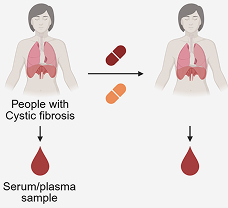
A study by Charité – Universitätsmedizin Berlin, the Max Delbrück Center (MDC) and the Berlin Institute of Health (BIH), published in Cell Systems, provides the first comprehensive insights into how modern CFTR modulators systemically affect the proteome in cystic fibrosis. CFTR modulators are drugs that improve the function of the frequently mutated cystic fibrosis transmembrane conductance regulator (CFTR) protein.
By comparing dual therapy (lumacaftor/ivacaftor) and triple therapy (elexacaftor/tezacaftor/ivacaftor), the DZKJ-researchers showed that the triple combination induces significantly stronger changes in the blood proteome and shifts it toward a healthier state—particularly in inflammatory and metabolic processes.
By integrating blood and sputum data, the study also demonstrates that local changes in the lung and systemic effects in the body only partially overlap. This is relevant for understanding molecular disease mechanisms and for the development of biomarkers. Of particular note is the protein SFTPB (surfactant protein B), which strongly correlates with lung function and shows reproducible changes under therapy. These findings were confirmed in an independent cohort.
The study was led by Dr. Kerstin Fentker and conducted in collaboration with the senior authors Dr. Philipp Mertins, Dr. Simon Gräber, and Prof. Marcus Mall.
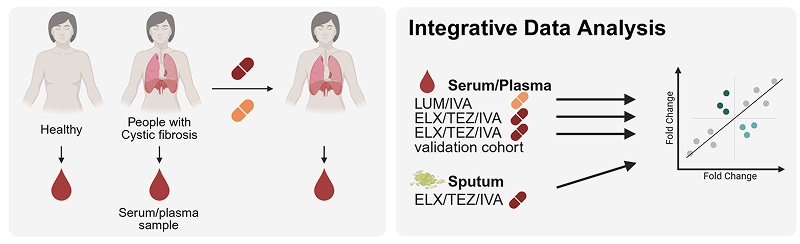
Image created using BioRender (https://www.biorender.com/)
© David Ausserhofer, Max Delbrück Center