Daily headaches in children are often classified as migraines. A study by the University Medical Center Göttingen (UMG) now shows that in many cases, a benign form of epilepsy may be the underlying cause of these symptoms. An accurate diagnosis allows for targeted treatment with anti-seizure medications and can significantly alleviate the symptoms within a short period of time.
When Max, then three years old, came to the University Medical Center Göttingen (UMG) in 2017, his parents sought help for his daily headaches. He would wake up repeatedly at night, thrash about, and sometimes even vomit.
Max underwent a comprehensive examination at the UMG’s Social Pediatric Center. Among other tests, an electroencephalogram (EEG) was performed to measure his brain waves. Although the symptoms initially suggested a migraine, the treating physicians suspected another possible cause: a specific form of epilepsy that can manifest primarily as headaches.
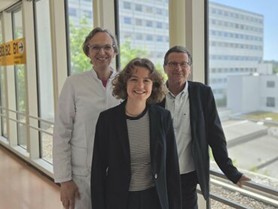
Max’s story is not an isolated case. Researchers at UMG analyzed data from 186 children aged three to 14 who had been referred to the Department of Pediatrics and Adolescent Medicine at UMG with a diagnosis of migraine or headaches. “With our study, we were able to show for the first time that, more often than previously assumed, so-called migraine attacks in children actually mask benign epilepsy. This finding is of great significance for the children affected, because unlike a migraine, this form of epilepsy can usually be treated very effectively,” says Prof. Dr. Knut Brockmann, senior physician at the Department of Pediatrics and Adolescent Medicine at UMG and DZKJ-PI.
The researchers retrospectively analyzed the medical histories, EEG findings, and treatment outcomes of 186 children. A total of 35 children (18.8 percent) received a possible, probable, or confirmed diagnosis of SeLEAS; in 12 children (6.5 percent), this form of epilepsy was even definitively diagnosed.
“Our goal is not for every child with headaches to be considered an epilepsy patient in the future. But if the symptoms are consistent with both migraine and SeLEAS, the possibility of epilepsy should always be considered. In these cases, an EEG can provide crucial clues and lead to the correct diagnosis at an early stage,” says Prof. Brockmann.
The full press release from Göttingen University Medical Center can be found at the following link: https://www.umg.eu/news-detail/news-detail/detail/news/migraene-oder-epilepsie-im-kindesalter-oft-schwer-zu-unterscheiden/
Department Contact:
Prof. Dr. Knut Brockmann, Department of Pediatrics and Adolescent Medicine, Phone 0160 / 97994073, knut.brockmann@med.uni-goettingen.de
Foto: umg/frank stefan kimmel